
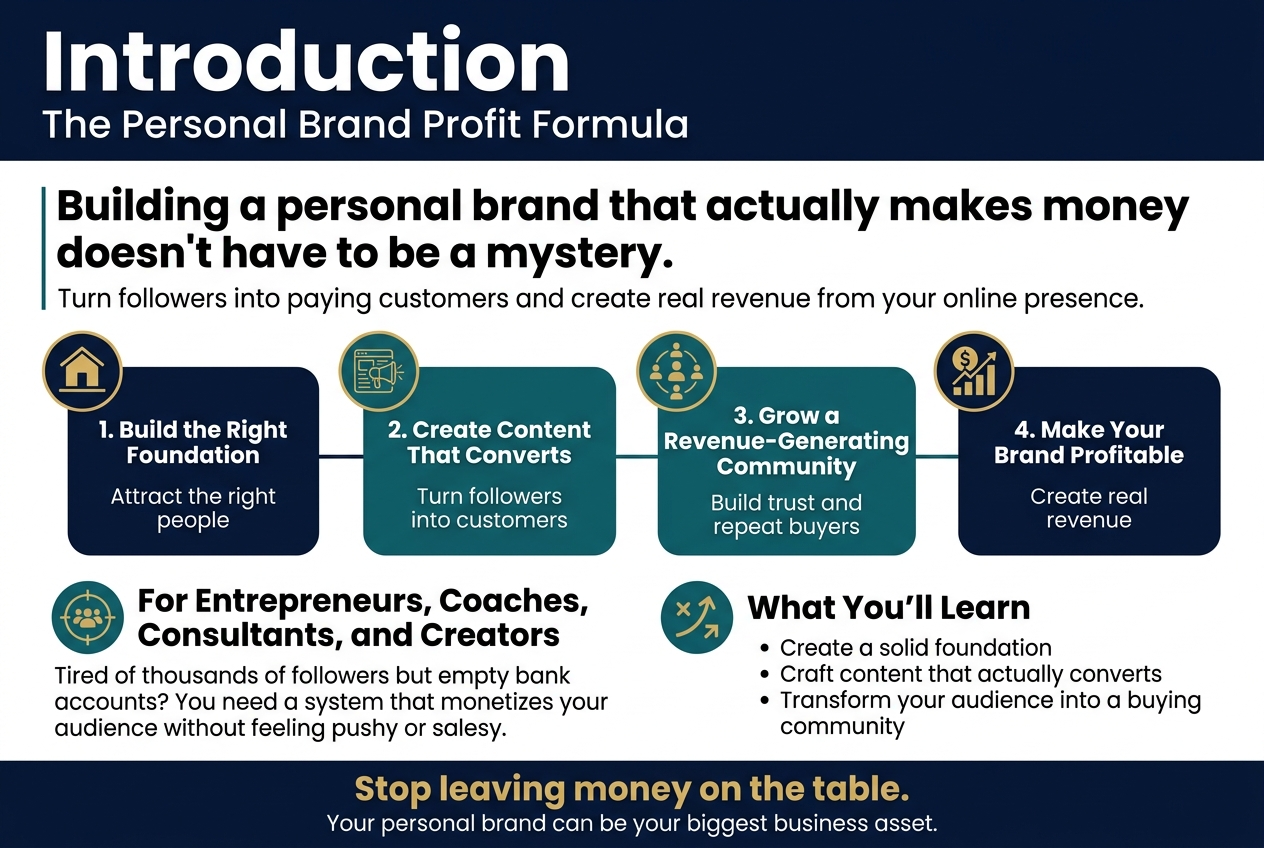
Building a personal brand that actually makes money doesn't have to be a mystery. The Personal Brand Profit Formula shows you exactly how to turn your followers into paying customers and create real revenue from your online presence.
This guide is for entrepreneurs, coaches, consultants, and creators who are tired of having thousands of followers but empty bank accounts. You've built an audience, but now you need to know how to monetize it without feeling pushy or salesy.
We'll walk through the essential building blocks for a profitable personal brand, starting with creating a solid foundation that attracts the right people. You'll learn how to craft content that actually converts followers into customers, not just gets likes and comments. Plus, we'll cover proven strategies to transform your audience into a revenue-generating community that buys from you again and again.
Stop leaving money on the table. Your personal brand can be your biggest business asset when you know the right formula to make it profitable.
Build Your Foundation for Monetizable Personal Branding
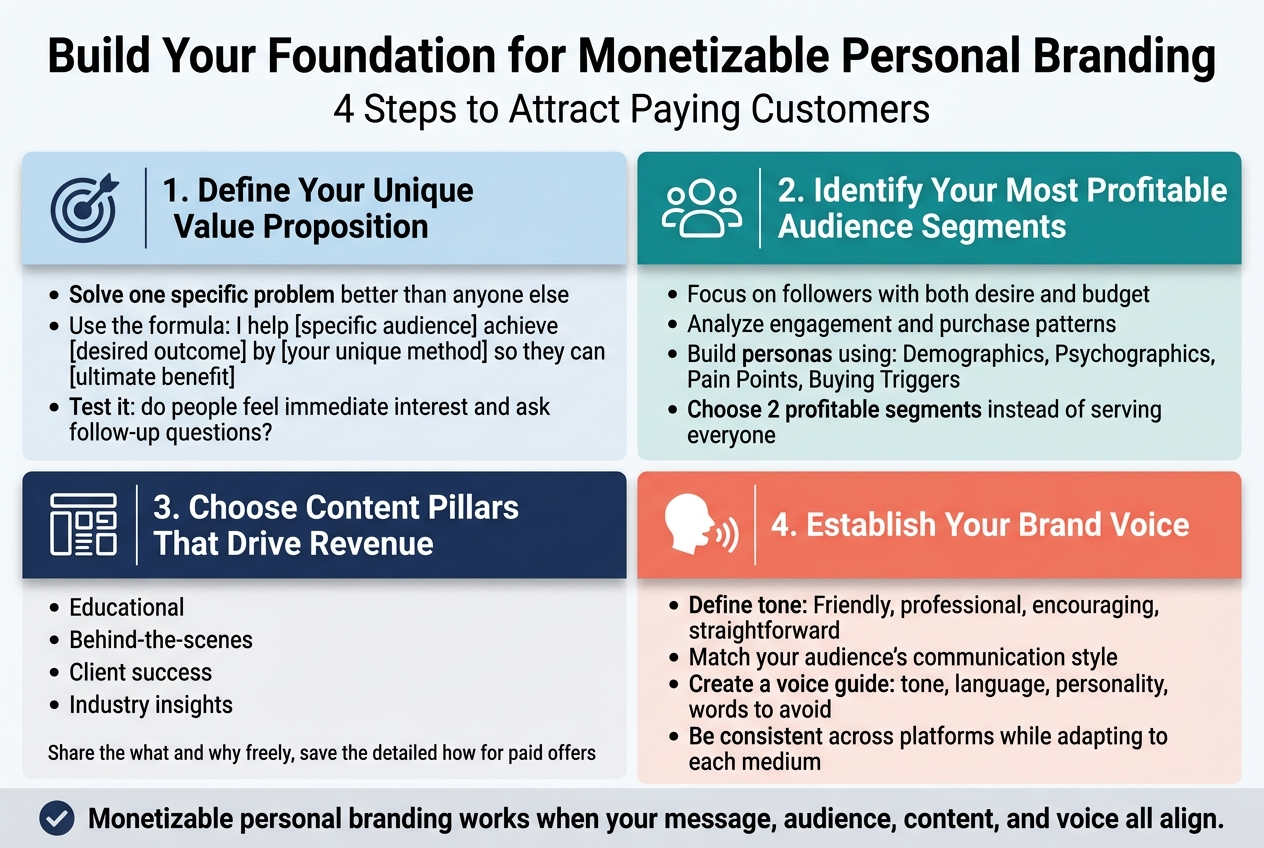
Define Your Unique Value Proposition That Attracts Paying Customers
Your value proposition is what makes people stop scrolling and actually care about what you're saying. Think about it - everyone's competing for attention online, so you need something that makes you stand out from the crowd.
Start by identifying the specific problem you solve better than anyone else. Maybe you help overwhelmed entrepreneurs streamline their workflows, or you teach introverts how to network without feeling drained. The key is getting super specific about who you help and what transformation you provide.
Here's a simple framework: "I help [specific audience] achieve [desired outcome] by [your unique method] so they can [ultimate benefit]." For example, "I help burned-out marketing managers create systems that cut their workload in half so they can finally have work-life balance."
Your unique angle might be your personal story, your unconventional approach, or your specific expertise combination. Maybe you're the former corporate lawyer who now teaches mindfulness to Type-A personalities. That backstory becomes part of your value proposition because it shows you understand their world.
Test your value proposition by sharing it with potential customers. Do their eyes light up? Do they immediately ask follow-up questions? If they seem confused or uninterested, you need to refine it until it creates an instant "that's exactly what I need" reaction.
Identify Your Most Profitable Target Audience Segments
Not all followers are created equal when it comes to revenue potential. Some people love your content but will never buy anything. Others might only purchase low-ticket items. Your job is finding the segments that have both the desire and the budget for your higher-value offerings.
Start by analyzing your current audience data. Look at who's already engaging most with your content and, more importantly, who's actually making purchases. What patterns do you see? Are they mostly entrepreneurs, corporate professionals, stay-at-home parents, or recent graduates?
Create detailed audience personas based on these high-value segments:
- Demographics: Age, income level, job title, industry
- Psychographics: Values, challenges, goals, shopping behavior
- Pain Points: What keeps them up at night? What frustrates them most?
- Buying Triggers: What motivates them to invest in solutions?
Don't try to serve everyone. It's better to deeply understand and serve two profitable segments than to create watered-down content for ten different groups. When you speak directly to someone's specific situation, they're willing to pay premium prices.
Research where these profitable segments spend their time online. Are they on LinkedIn discussing industry trends? Instagram looking for lifestyle inspiration? YouTube learning new skills? This knowledge helps you create content that reaches them where they're already engaged.
Choose Content Pillars That Drive Revenue Opportunities
Your content pillars should naturally lead people toward your paid offerings without feeling salesy or forced. Each pillar needs to demonstrate your expertise while creating desire for deeper transformation.
Select 3-4 core themes that showcase different aspects of your expertise:
| Content Pillar | Purpose | Revenue Connection |
|---|---|---|
| Educational | Show expertise and build trust | Positions you as the go-to expert |
| Behind-the-scenes | Humanize your brand | Creates connection that drives loyalty |
| Client success | Social proof and results | Demonstrates ROI of working with you |
| Industry insights | Thought leadership | Attracts high-value prospects |
Each pillar should answer questions your ideal customers are asking while subtly highlighting gaps that your paid services fill. For instance, if you offer a course on email marketing, your educational content might cover basic strategies while hinting at advanced techniques available in your program.
Create content that provides genuine value but leaves people wanting more depth. Share the "what" and "why" freely, but save the detailed "how" for your paid offerings. This approach builds trust while creating natural demand for your products and services.
Plan your content calendar around these pillars, ensuring each piece serves your revenue goals while genuinely helping your audience. The best monetizable content doesn't feel like marketing - it feels like valuable education that happens to come from someone who can help even more.
Establish Your Brand Voice for Maximum Market Appeal
Your brand voice is how your personality comes through in everything you write and say. It's what makes people feel like they know you personally, even if you've never met. Getting this right can make the difference between someone scrolling past or becoming a loyal customer.
First, define your personality traits. Are you encouraging and supportive? Direct and no-nonsense? Playful and humorous? Your voice should reflect who you actually are, not who you think you should be. Authenticity resonates more than perfection.
Consider your audience's communication style too. If you're targeting C-suite executives, your voice might be more polished and strategic. If you're speaking to creative freelancers, you might be more casual and encouraging. The sweet spot is where your natural personality meets your audience's preferences.
Create a voice guide that includes:
- Tone descriptors: Friendly, professional, encouraging, straightforward
- Language preferences: Industry jargon vs. simple terms, formal vs. casual
- Personality traits: What makes you uniquely you
- Words and phrases to avoid: Anything that doesn't feel authentic
Your voice should be consistent across all platforms while adapting to each medium's style. Your LinkedIn posts might be slightly more professional than your Instagram captions, but the core personality should shine through everywhere.
Practice your voice by recording yourself speaking naturally about your expertise, then transcribing and analyzing the language patterns. This helps you write the way you actually talk, which creates stronger connections with your audience and makes them more likely to trust you with their money.
Create Content That Converts Followers Into Customers
Develop High-Value Content That Showcases Your Expertise
Your expertise is your currency, but only when you package it right. The biggest mistake content creators make is dumping information without context or connection. Your followers need to see the transformation you can deliver, not just the knowledge you possess.
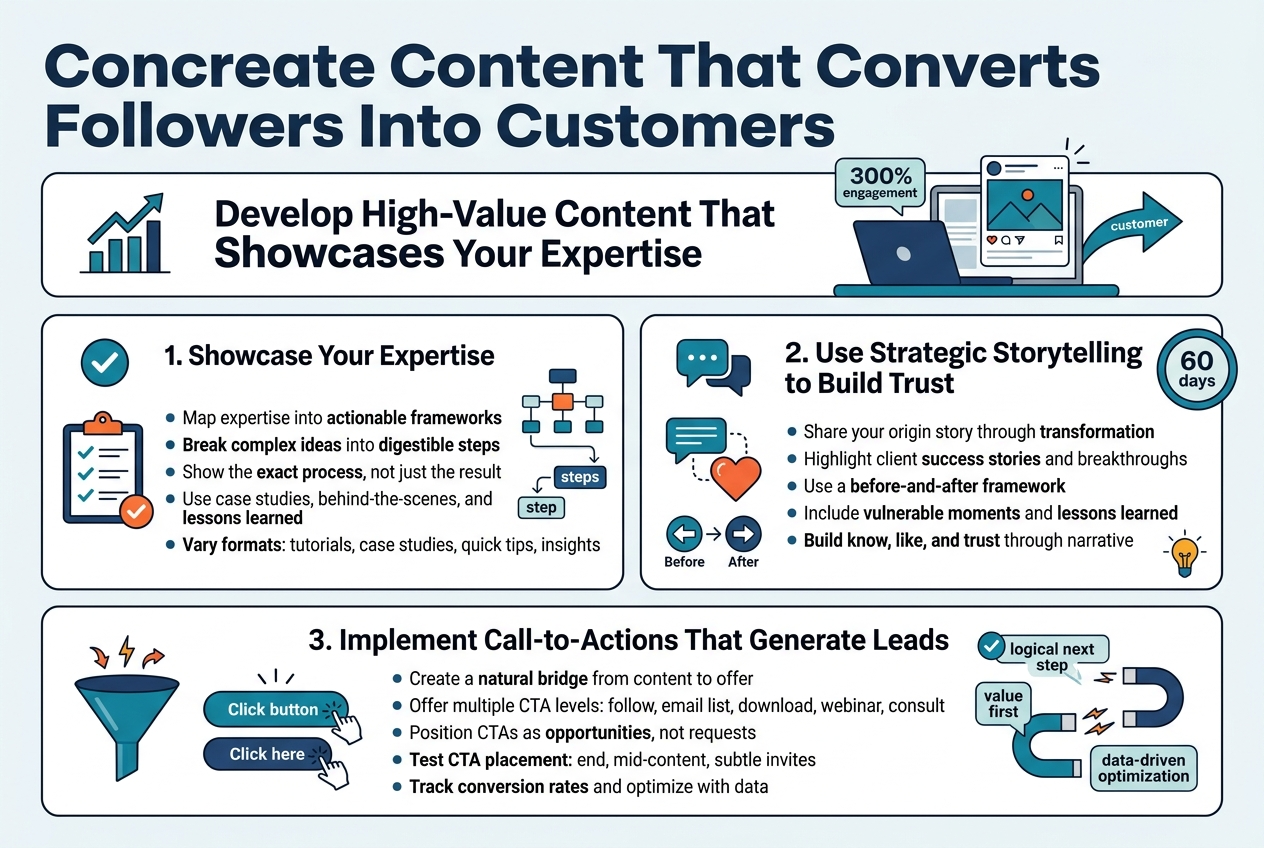
Start by mapping out your expertise into actionable frameworks. Break down complex concepts into digestible steps that your audience can immediately apply. For instance, if you're a marketing consultant, don't just talk about "building brand awareness." Instead, share the exact 5-step process you used to help a client increase their social media engagement by 300% in 60 days.
Document your process, not just your results. People buy methodology, not miracles. When you share the specific tools, templates, and thought processes behind your success, you're giving your audience a preview of what working with you looks like.
Create content that solves problems before your audience even realizes they have them. This positions you as a thought leader who anticipates market shifts and customer needs. Share case studies, behind-the-scenes looks at your work, and lessons learned from both victories and failures.
Remember to vary your content formats. Some people learn through tutorials, others through case studies, and many through quick tips. Mix educational posts, industry insights, personal experiences, and tactical advice to keep your expertise showcase fresh and engaging.
Use Strategic Storytelling to Build Trust and Authority
Stories sell because they create emotional connections that facts alone can't achieve. Your personal brand needs narratives that make your audience feel like they know, like, and trust you before they ever meet you.
Share your origin story, but make it about the transformation, not the trauma. Your audience wants to understand your journey because it helps them visualize their own potential transformation. Focus on the pivotal moments that shaped your expertise and the lessons that drive your current approach.
Client success stories are pure gold for building authority. However, don't just share the happy endings. Walk your audience through the challenges, the process, and the breakthrough moments. This shows your problem-solving skills in action and helps prospects understand how you work.
Use the before-and-after framework consistently. Whether you're talking about a client, a personal experience, or an industry trend, structure your stories around the transformation. This pattern trains your audience to see you as someone who creates positive change.
Include vulnerable moments that show your humanity while reinforcing your expertise. Share the mistakes you made early in your career and how they led to your current wisdom. This builds trust because it shows you're real, and it builds authority because it demonstrates growth and learning.
Implement Call-to-Actions That Generate Leads
Every piece of content needs a clear next step, but your call-to-action shouldn't feel like a used car sales pitch. The best CTAs provide value while moving people deeper into your ecosystem.
Create a natural bridge between your content and your offer. If you just shared a framework for improving productivity, your CTA might invite people to download a more detailed template or checklist. The key is making the next step feel like a logical continuation of the value you just provided.
Use multiple CTAs with different commitment levels. Not everyone is ready to book a consultation after reading one blog post. Offer a range of options: follow you on social media, join your email list, download a free resource, attend a webinar, or schedule a discovery call. This gives people choice while capturing them at their current level of interest.
Position your CTAs as opportunities, not requests. Instead of "Sign up for my newsletter," try "Get weekly strategies that successful entrepreneurs use to scale their businesses." Frame the action around the benefit they'll receive.
Test different CTA placements and styles. Some audiences respond better to direct calls at the end of content, while others prefer subtle invitations woven throughout. Mid-content CTAs often work well when you've just provided significant value and your audience is feeling grateful.
Track your conversion rates and optimize based on data, not assumptions. What works for other creators might not work for your audience, so pay attention to which CTAs generate the most engagement and leads for your specific community.
Transform Your Audience Into a Revenue-Generating Community
Build Genuine Relationships That Foster Customer Loyalty
Stop treating your audience like numbers on a screen. Your followers are real people with real problems, dreams, and stories. When you shift from broadcasting to connecting, something magical happens – people start buying from you because they trust you, not just because you're selling something.
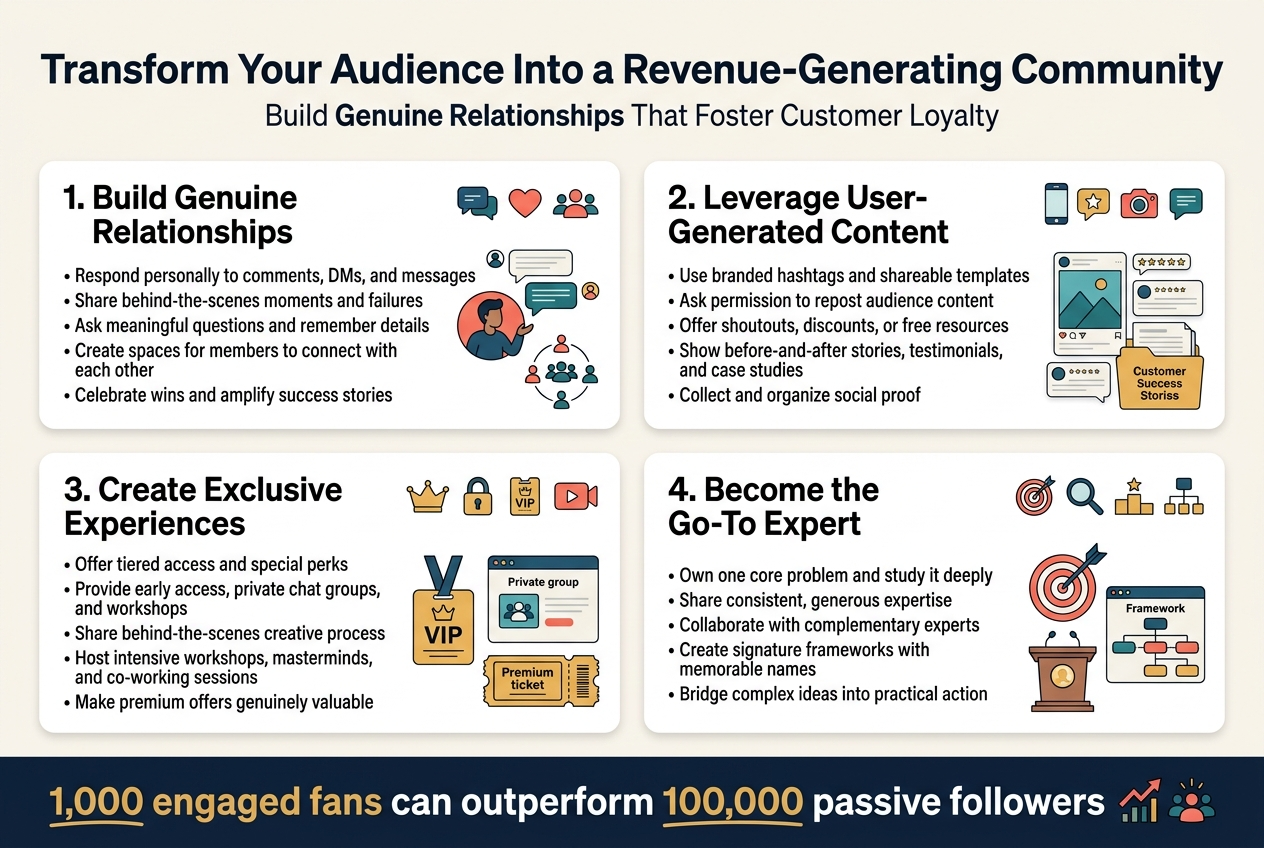
Start by responding to every comment, DM, and message personally. Share behind-the-scenes moments that show your human side. Talk about your failures, not just your wins. Ask questions that matter and actually listen to the answers. Remember details about your community members and check in on them regularly.
Create spaces where your audience can connect with each other, not just with you. Host live Q&A sessions, run polls asking for their opinions, and celebrate their wins publicly. When someone shares their success story using your advice, amplify it across all your platforms.
The goal isn't to have the biggest following – it's to have the most engaged one. A community of 1,000 people who genuinely care about what you're doing will always outperform 100,000 passive scrollers when it comes to revenue generation.
Leverage User-Generated Content for Social Proof
Your best marketing team is already following you – it's your audience. When real people share real results from working with you, that carries more weight than any sales copy you could write.
Make it ridiculously easy for people to share their experiences. Create branded hashtags, design shareable templates, and always ask for permission to repost their content. Offer small incentives like shoutouts, discounts, or free resources for people who share their journey.
Document transformation stories through before-and-after posts, video testimonials, and case studies. Show the process, not just the outcome. People connect with struggle and progress more than they connect with overnight success stories that feel impossible to replicate.
Set up systems to collect and organize this content. Screenshot positive comments, save video testimonials, and create a folder of customer success stories you can pull from when creating sales content. This social proof becomes the backbone of your marketing strategy.
Create Exclusive Experiences That Justify Premium Pricing
Exclusivity drives desire. When people feel like they're part of something special, they're willing to pay more for that privilege. Your job is to create experiences that feel valuable and exclusive without being artificially scarce.
Develop a tiered access system where your most committed community members get special perks. This might include early access to new content, monthly group calls, direct access to you through a private chat group, or exclusive workshops that aren't available to the general public.
Behind-the-scenes content works particularly well here. Share your creative process, let people watch you work, or give them insight into how you make decisions in your business. People love feeling like insiders who get to see what others don't.
Create limited-time experiences like intensive workshops, mastermind groups, or co-working sessions. The key is making these feel genuinely valuable, not just expensive. Your premium offerings should solve bigger problems or provide deeper transformation than your free content.
Establish Yourself as the Go-To Expert in Your Niche
Being known as "the person who talks about everything" won't make you money. Being known as "the person who solves this specific problem better than anyone else" will change your bank account.
Pick one core problem you solve and become obsessed with it. Study every angle, learn every solution, and understand it better than anyone else in your space. Then share that knowledge consistently and generously. Answer the same questions a hundred different ways until people start tagging you when someone else asks about that topic.
Collaborate with other experts in complementary niches rather than competing with people in your exact space. Guest on podcasts, write for industry publications, and participate in expert panels. The goal is to be invited to tables where your ideal clients are sitting.
Create signature frameworks, methodologies, or systems that are uniquely yours. Give them memorable names and teach them consistently across all your platforms. When people think about your area of expertise, your specific approach should be the first thing that comes to mind.
Position yourself as the bridge between complex industry knowledge and practical application. Your audience doesn't need another guru – they need someone who can take complicated concepts and make them actionable for their specific situation.
Diversify Your Income Streams Through Personal Branding
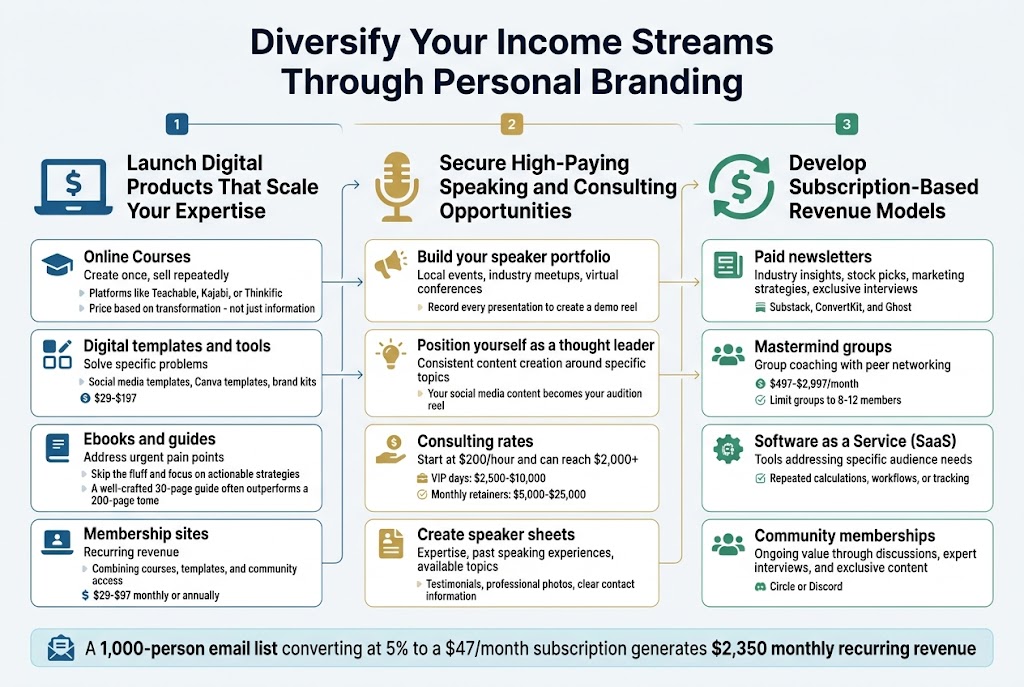
Launch Digital Products That Scale Your Expertise
Digital products represent the most scalable way to monetize your personal brand. Unlike one-on-one services, you create them once and sell them repeatedly without additional time investment.
Online Courses work exceptionally well for personal brands with specialized knowledge. Platforms like Teachable, Kajabi, or Thinkific make course creation straightforward. Price your courses based on the transformation you provide - not just the information. A $497 course that helps someone land a $10,000 raise is actually underpriced.
Digital templates and tools solve specific problems your audience faces regularly. If you're a marketing expert, create social media templates. Designers can sell Canva templates or brand kits. These products typically range from $29-$197 and appeal to DIY-minded followers.
Ebooks and guides work best when they address urgent pain points. Skip the fluff and focus on actionable strategies. A well-crafted 30-page guide often outperforms a 200-page tome filled with theory.
Membership sites combining courses, templates, and community access create recurring revenue. Members pay monthly ($29-$97) or annually for ongoing access to your expertise and exclusive content.
Secure High-Paying Speaking and Consulting Opportunities
Speaking engagements and consulting work represent some of the highest-paying opportunities for personal brands. Corporate events often pay $5,000-$50,000+ for keynote speakers with strong personal brands.
Build your speaker portfolio by starting with local events, industry meetups, and virtual conferences. Record every presentation to create a demo reel showcasing your speaking style and expertise. Professional video clips are worth the investment.
Position yourself as a thought leader through consistent content creation around specific topics. Companies hire speakers who can provide fresh perspectives on challenges their teams face. Your social media content becomes your audition reel.
Consulting rates for personal brand experts typically start at $200/hour and can reach $2,000+ for specialized expertise. Package your consulting into VIP days ($2,500-$10,000) or monthly retainers ($5,000-$25,000) rather than selling hourly time.
Create speaker sheets highlighting your expertise, past speaking experiences, and available topics. Include testimonials, professional photos, and clear contact information. Make it easy for event organizers to say yes.
Develop Subscription-Based Revenue Models
Subscription models provide predictable monthly income that compounds over time. A 1,000-person email list converting at 5% to a $47/month subscription generates $2,350 monthly recurring revenue.
Paid newsletters work particularly well for personal brands sharing industry insights, stock picks, marketing strategies, or exclusive interviews. Substack, ConvertKit, and Ghost make newsletter monetization simple.
Mastermind groups combining group coaching with peer networking command premium prices ($497-$2,997/month). Limit groups to 8-12 members for intimacy and provide structured monthly calls with hot seats and accountability.
Software as a Service (SaaS) tools addressing specific audience needs create the most valuable subscription businesses. If your audience repeatedly asks about certain calculations, workflows, or tracking, consider building a simple tool.
Community memberships on platforms like Circle or Discord provide ongoing value through discussions, expert interviews, and exclusive content. Price these based on the networking value and expertise access you provide.
| Subscription Type | Typical Price Range | Best For |
|---------------
Optimize Your Sales Funnel for Maximum Revenue Conversion
Design Lead Magnets That Attract Quality Prospects
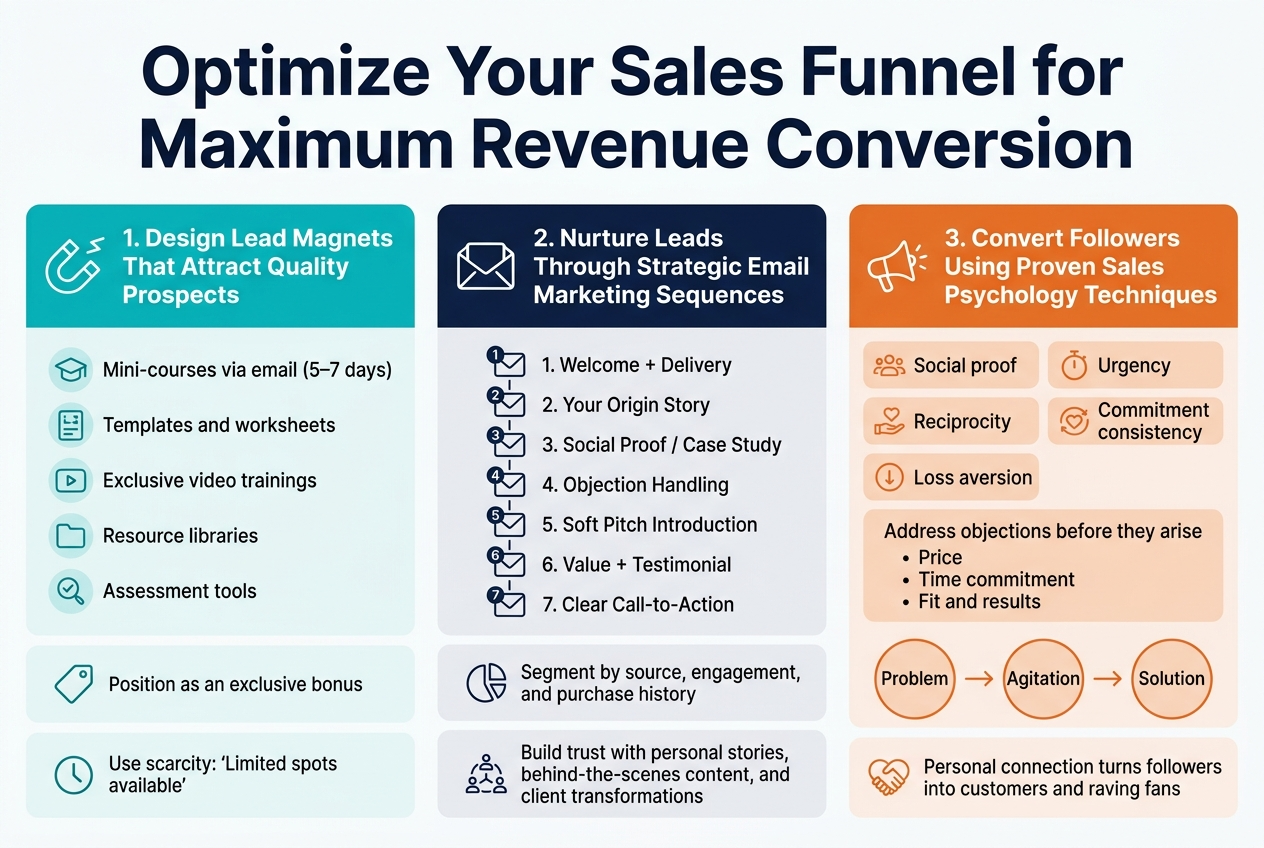
Your lead magnet acts as the gateway between casual followers and potential customers. The best lead magnets solve a specific, urgent problem your target audience faces while showcasing your expertise. Think beyond generic checklists and create something your ideal prospects would actually pay for.
Start by identifying the biggest pain point your audience struggles with right before they're ready to buy from you. If you're a business coach, maybe it's creating their first sales process. If you're a fitness trainer, it could be meal planning for busy professionals. Your lead magnet should provide immediate value while naturally leading to your paid offerings.
High-Converting Lead Magnet Formats:
- Mini-courses delivered via email over 5-7 days
- Templates and worksheets that save hours of work
- Exclusive video trainings addressing specific challenges
- Resource libraries curated for your niche
- Assessment tools that provide personalized insights
The key lies in positioning your lead magnet as an exclusive bonus rather than free content. People value what they "pay" for with their email address more than completely free resources. Use scarcity and urgency in your messaging: "Limited spots available" or "Only accessible this week."
Place your lead magnet strategically across all touchpoints - your bio links, story highlights, email signature, and content calls-to-action. Track which sources bring the highest-quality leads by monitoring engagement rates and eventual conversion to paid offers.
Nurture Leads Through Strategic Email Marketing Sequences
Email marketing remains the highest ROI channel for personal brands, but only when executed strategically. Your nurture sequence should build trust, demonstrate expertise, and gradually introduce your paid offerings without feeling salesy.
Design your welcome sequence to deliver on your lead magnet's promise while establishing your authority. The first email should arrive immediately with the promised resource plus a personal story about why you created it. Email two might share a case study of someone who implemented your advice. Email three could address common objections or mistakes people make.
Effective Nurture Sequence Structure:
- Welcome + Delivery (immediate)
- Your Origin Story (day 2)
- Social Proof/Case Study (day 4)
- Objection Handling (day 7)
- Soft Pitch Introduction (day 10)
- Value + Testimonial (day 14)
- Clear Call-to-Action (day 18)
Personalization goes beyond using someone's first name. Segment your list based on lead magnet source, engagement level, and past purchases. Someone who downloads your beginner's guide needs different messaging than someone accessing your advanced strategy template.
Share behind-the-scenes content, personal struggles, and client transformations. People buy from those they know, like, and trust. Your vulnerability creates connection, while your expertise builds confidence in your ability to help them achieve results.
Convert Followers Using Proven Sales Psychology Techniques
Converting followers into customers requires understanding the psychological triggers that drive purchase decisions. Social proof, urgency, and reciprocity form the foundation of effective conversion strategies.
Social proof works because people follow the crowd when uncertain about decisions. Showcase testimonials prominently across your platforms, but make them specific. Instead of "Amazing results!" use "Increased my revenue by 40% in three months using Sarah's framework." Include photos, video testimonials, and detailed case studies showing the transformation process.
Create genuine urgency through limited-time bonuses, early-bird pricing, or exclusive access periods. Avoid fake countdown timers that reset - your audience notices these tactics and loses trust. Real urgency comes from legitimate constraints like your availability, group coaching cohort sizes, or seasonal relevance.
Psychological Triggers for Higher Conversions:
- Authority positioning through media mentions and credentials
- Reciprocity via valuable free content before pitching
- Commitment consistency by getting small agreements first
- Loss aversion by highlighting what they'll miss without action
- Community belonging through exclusive groups and insider access
Address objections before they arise. Common concerns include price, time commitment, and whether your solution works for their specific situation. Create content that tackles these hesitations head-on through FAQ videos, comparison charts, and detailed explanations of your process.
Use the "PAS" framework - Problem, Agitation, Solution - in your sales content. Identify their pain point, help them feel the cost of inaction, then present your offer as the logical solution. This psychological journey moves people from awareness to desire to action.
The strongest conversion tool remains personal connection. Respond to comments, engage in DMs, and show genuine interest in your followers' success. When people feel seen and valued as individuals, they become customers and raving fans who refer others to your business.
Scale Your Personal Brand Business for Long-Term Profitability
Automate Revenue-Generating Processes
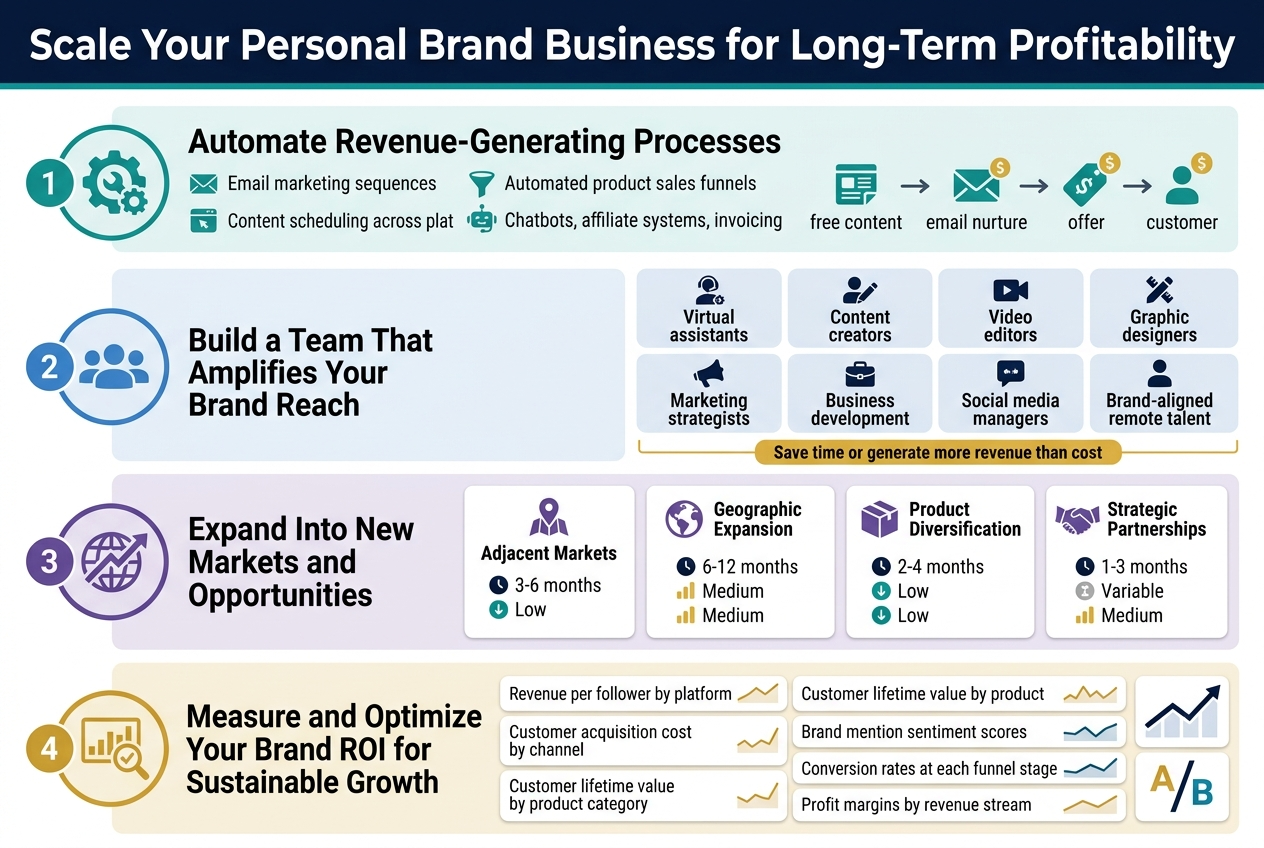
Smart automation is your ticket to earning money while you sleep. Start with email marketing sequences that nurture leads and convert them into paying customers without constant manual intervention. Set up automated product sales funnels that guide prospects through your value ladder, from free content to premium offerings.
Consider automating your content distribution across multiple platforms using scheduling tools. This keeps your brand visible and engaging even when you're focused on other business activities. Automated customer service chatbots can handle common questions and direct people to appropriate resources, freeing up your time for high-value activities.
Don't overlook automated affiliate marketing systems. Once you establish partnerships with relevant brands, these relationships can generate passive income through trackable links and codes. Set up automated invoicing and payment processing for your services to eliminate manual financial tasks.
The key is starting small and gradually expanding your automation stack. Begin with one process that takes up significant time, automate it successfully, then move to the next. This approach prevents overwhelming yourself while building systems that compound your earning potential over time.
Build a Team That Amplifies Your Brand Reach
Growing beyond solo operations requires strategic team building that extends your personal brand's influence. Start by identifying tasks that don't require your unique voice or expertise. Virtual assistants can handle administrative work, social media scheduling, and customer inquiries, allowing you to focus on content creation and relationship building.
Content creators who understand your brand voice can produce additional material across different formats. A skilled video editor can transform your raw footage into polished content that maintains your personal touch while reaching professional standards. Graphic designers can create consistent visual branding that reinforces your message across all platforms.
Consider hiring specialists for areas outside your expertise. A marketing strategist can optimize your campaigns, while a business development professional can pursue partnership opportunities. Social media managers who specialize in your niche can expand your reach organically.
When building your team, prioritize people who genuinely connect with your brand values. They become authentic extensions of your message rather than just hired hands. Provide clear brand guidelines and regular feedback to maintain consistency. Remote work tools enable you to access global talent while keeping costs manageable.
Remember that each team member should either save you time or generate more revenue than their cost. Track these metrics carefully to ensure your team investments contribute to profitable growth.
Expand Into New Markets and Revenue Opportunities
Market expansion multiplies your revenue potential without starting from scratch. Analyze your current audience demographics and psychographics to identify adjacent markets that would appreciate similar value. If you serve small business owners in retail, consider expanding to restaurant owners or service providers who face comparable challenges.
Geographic expansion opens doors to international audiences. Adapt your content and offerings to different cultural contexts while maintaining your core message. Time zone differences can actually work in your favor, allowing you to serve global audiences around the clock.
Product diversification creates multiple revenue streams from your existing expertise. Transform your coaching sessions into online courses, your blog content into published books, or your speaking topics into workshop curriculums. Each format appeals to different learning preferences and budget levels.
Strategic partnerships accelerate market entry. Collaborate with established brands in new niches to gain instant credibility and access to their audiences. Joint ventures, affiliate relationships, and co-created products can introduce your brand to markets that would take years to penetrate independently.
| Expansion Strategy | Timeline | Investment Level | Risk Level |
|---|---|---|---|
| Adjacent Markets | 3-6 months | Low | Low |
| Geographic Expansion | 6-12 months | Medium | Medium |
| Product Diversification | 2-4 months | Low | Low |
| Strategic Partnerships | 1-3 months | Variable | Medium |
Measure and Optimize Your Brand ROI for Sustainable Growth
Data-driven optimization separates profitable personal brands from those that plateau. Track revenue per follower across different platforms to identify which audiences convert best. This metric reveals where to focus your content efforts for maximum financial return.
Monitor customer lifetime value to understand the long-term impact of your brand building efforts. A lower-priced product that leads to repeat purchases and referrals often provides better ROI than one-time high-ticket sales. Calculate acquisition costs for different marketing channels to allocate budget effectively.
Brand sentiment analysis through social listening tools reveals how market perception affects your revenue potential. Positive brand associations increase pricing power and customer loyalty, while negative trends require immediate attention before they impact sales.
Set up conversion tracking for every touchpoint in your customer journey. Know which content types drive the most leads, which platforms generate the highest-quality prospects, and which offers convert best. A/B test everything from headlines to pricing strategies.
Financial metrics to monitor monthly:
- Revenue per follower by platform
- Customer acquisition cost by channel
- Customer lifetime value by product category
- Brand mention sentiment scores
- Conversion rates at each funnel stage
- Profit margins by revenue stream
Regular optimization based on these insights ensures your personal brand remains profitable and scalable. What works today might not work tomorrow, so consistent measurement and adjustment keep you ahead of market changes.
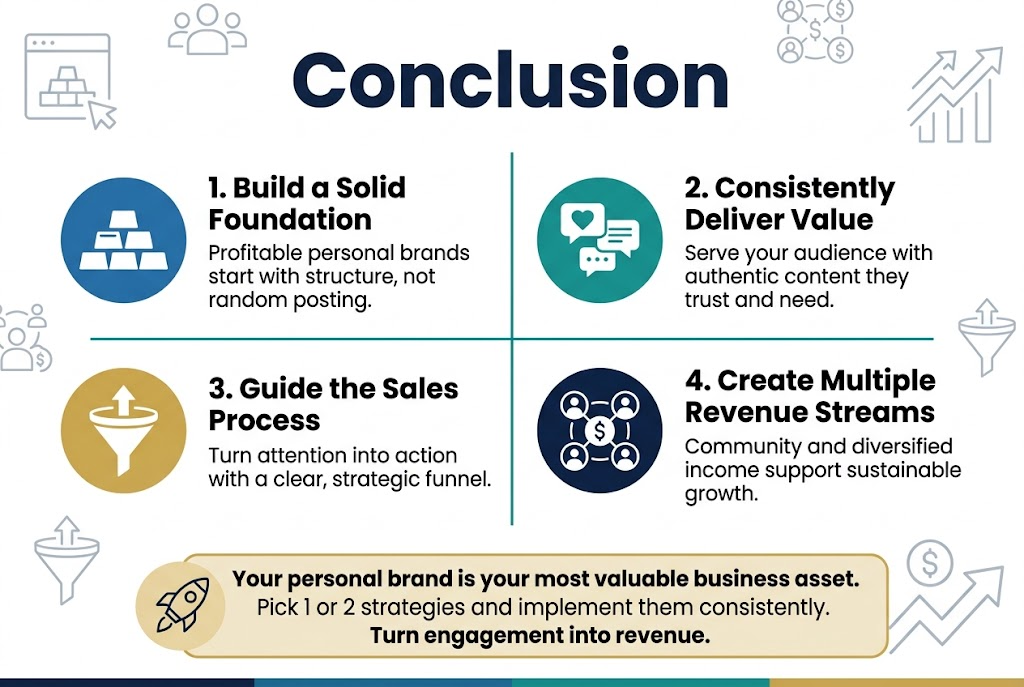
Building a profitable personal brand isn't just about posting content and hoping for the best. The real magic happens when you create a solid foundation, consistently deliver value to your audience, and strategically guide them through your sales process. By focusing on authentic content creation, community building, and multiple revenue streams, you're setting yourself up for sustainable income that grows alongside your influence.
Your personal brand is your most valuable business asset, and treating it like one changes everything. Start by picking one or two strategies from this formula and implementing them consistently. Whether that's optimizing your current sales funnel or exploring a new income stream, the key is taking action and staying committed to serving your audience. The followers are already there – now it's time to turn that engagement into the revenue you deserve.
0 Comments